The opening ceremonies of both Kettering Library and Alfred East Gallery were grand occasions that saw Sheep Street lined with thousands of people. But as the expectant crowds gathered outside and listened to ceremonial speeches, one woman patiently waited inside, ready for the doors to open.
As Kettering’s first Chief Librarian in 1904, she was inside and out of view when Andrew Carnegie opened the Library doors to applause from the onlookers.
And as Deputy Curator of Alfred East Gallery in 1913, she was again out of sight as Earl Spencer opened the Gallery doors for the first time.
While these men gave their speeches on the steps outside, she stood inside, ready to do the job she had always done and serve the people of Kettering. In a life dedicated to public service, she overcame prejudice and fought back against misogyny to become a pioneer in a male dominated profession.
Her name was Kate Pierce, and this is her story.
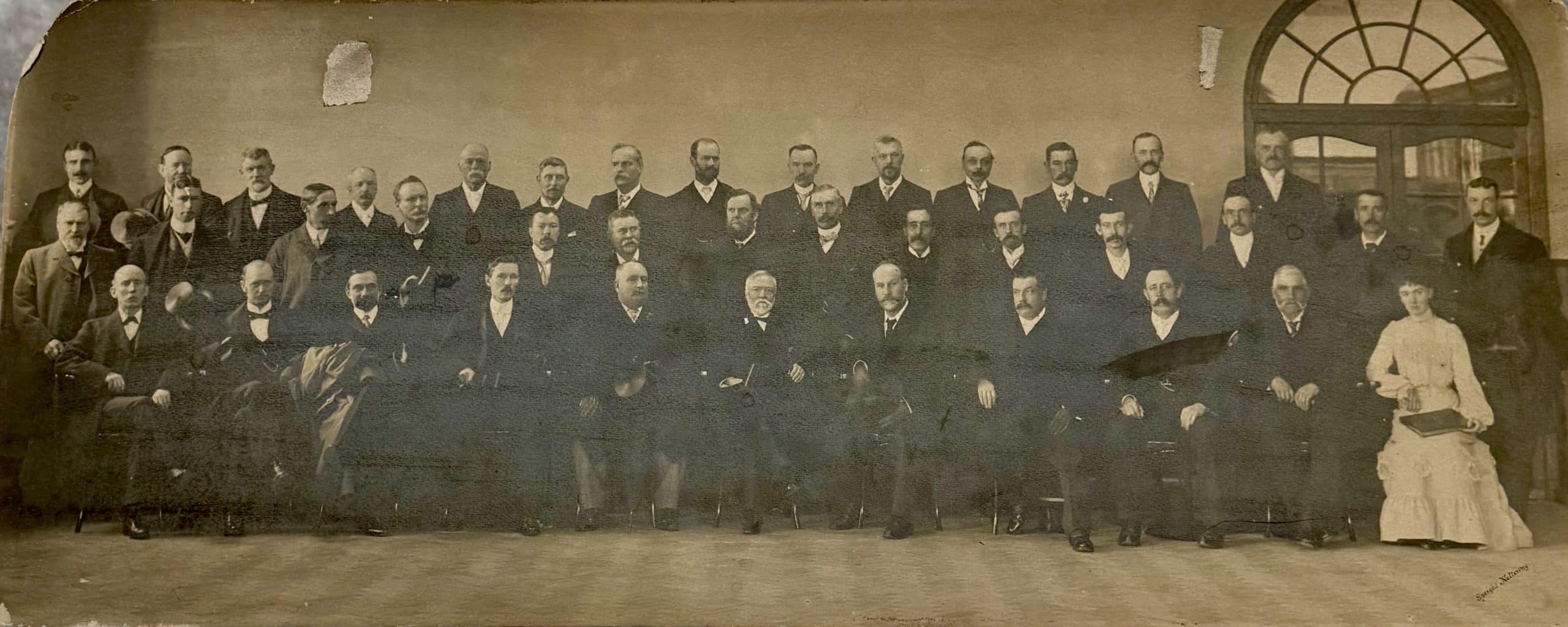
38 men and one woman – a group photo inside the Library on opening day, with Pierce seated on the right. (“Souvenir of Opening of Kettering Public Library”, 1904)
On 30th November 1873, an attorney’s clerk named Edward Pierce and his wife Emma welcomed their first child into the world – Kate Edith Pierce. Their home was on Green Lane Terrace, Kettering, and as a child Pierce attended the private day and boarding school a short distance away, South College on London Road.
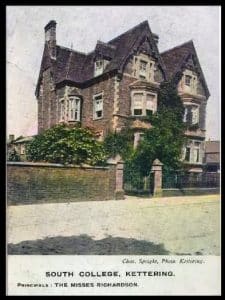
South College in 1906 (Speight postcard)
Located opposite the junction of St Mary’s Road and now private residences, South College was in the centre of a growing new town, a place where Pierce lived and worked until her retirement. The town was expanding quickly but for Pierce, her home, education, and future career were in the heart of Kettering.
After finishing her education, Pierce remained at South College as a pupil teacher. But her interests lay elsewhere – over the latter half of the 19th century, public libraries had started to appear around the country, part of a movement to provide education and enlightenment to the working classes. Local boroughs began establishing public libraries, free at the point of use, giving access to knowledge and literature that was previously out of reach.
Pierce wanted to be part of the Free Library Movement, and when the local council identified the need for a library in Kettering, she was hired as the town’s first Chief Librarian. It was 1896 and there were only around 240 public libraries in England, the vast majority of which were managed by men. While women were sometimes employed as assistants, few were given leadership roles. At just 23 years old, Pierce became only the 17th female Chief Librarian.
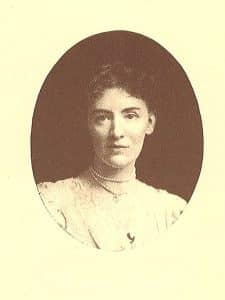
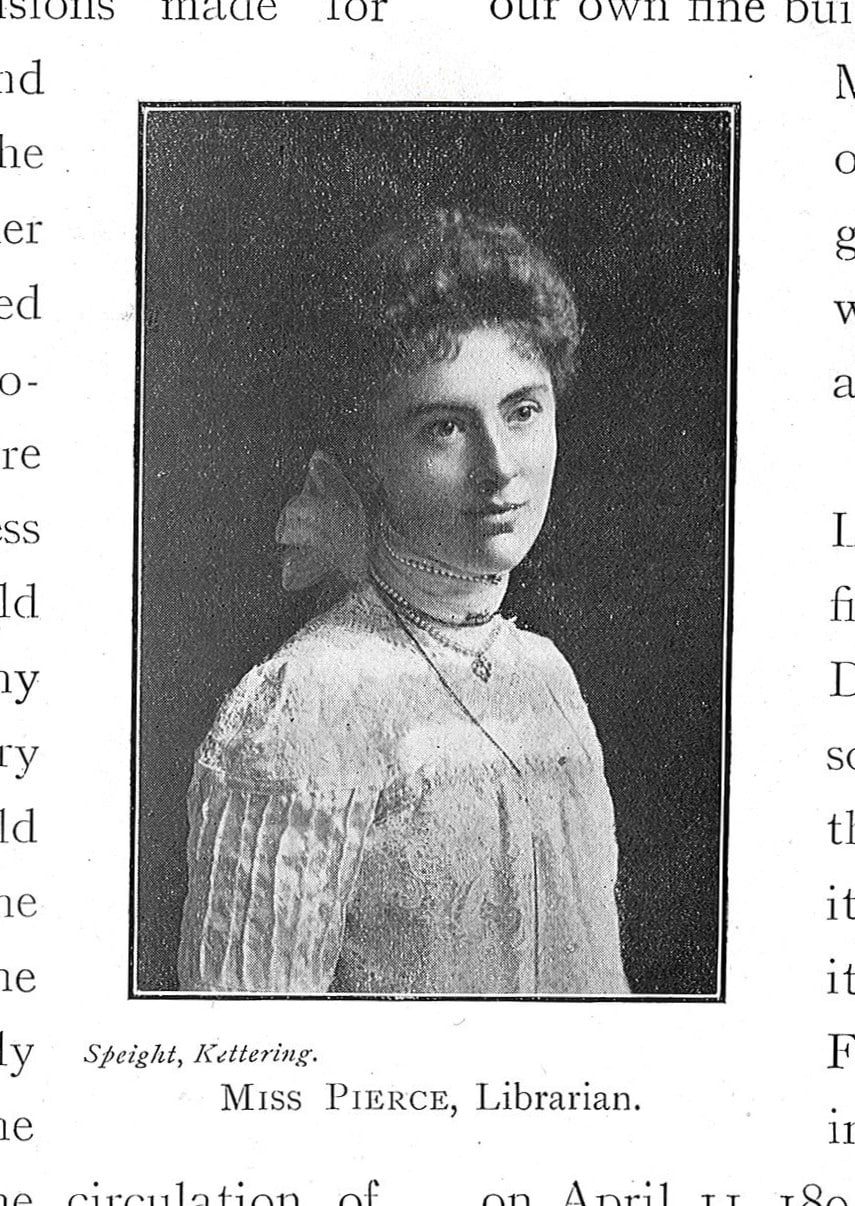
Pierce pictured in 1904 (A Pictorial History of Kettering)
With no formal apprenticeships or qualifications available, Pierce received training at Clerkenwell Public Library in London. There, under the mentorship of James Duff Brown, she learned how to manage a modern public library. Pierce later credited Brown for “inspire[ing] me with enthusiasm”.
A library in Kettering would need somewhere to call home. “After various buildings had been inspected,” Pierce later wrote, “the Town Hall [today’s Kino Lounge on Market Place]… was finally taken at a rental of £50 per annum”. Initially stocked with 1,660 books, it also contained a “newsroom” which Pierce proudly stated had “15 daily and 21 weekly newspapers, and 17 monthly magazines”, all available to the people of Kettering to read for free.
“It was amazing to see the number of empty shelves!”
Her time in Clerkenwell with JD Brown convinced Pierce that a new modern system should be adopted in Kettering’s library from day one. “Open Access” was a pioneering new method that allowed library users to freely browse the books on the shelves. Before this, bookshelves were only accessible by staff members. To borrow a book, you would first examine a catalogue of what was available before making your request at the library counter. A librarian would then find the requested book and bring it to you.
Open Access did away with this closely regulated system. Today, it is the norm and we perhaps take for granted the ability to freely wander around a library, browsing the shelves and leafing through the pages of any book that interests us. Pierce was at the forefront of this new system, and Kettering Library was designed entirely around it, one of only four Open Access libraries in the country.
The Library was an instant success. After only 5 years, it was clear that it had outgrown the Town Hall and larger premises were required. In 1901, the Library moved to its second home in the Victoria Hall Mission on Silver Street, for an annual rent of £80. Demand was rising. “The continual cry of the increasing number of borrowers was for books, books, and still more books,” Pierce later wrote. “It was amazing to see the number of empty shelves!”.
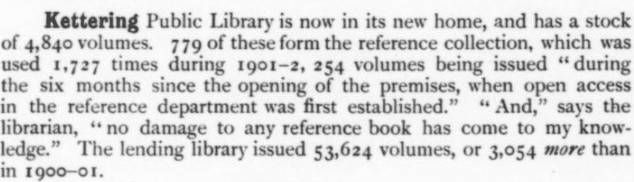
Library World, 1902. The Librarian quoted is Pierce, defending the Open Access system by highlighting the lack of damaged books.
The stay in Silver Street was short lived as enthusiasm for Pierce’s library continued to grow. Andrew Carnegie, the Scottish-American philanthropist, had been steadily donating his vast wealth to aid the Free Library Movement since the early 1880s, and he would go on to fund more than 2,500 public libraries around the world. In June 1903, an application was made to Carnegie for funds to build a new library in Kettering. When the council received his reply, the bells of the Parish Church rang in celebration – Carnegie agreed to donate £8,000 to the town.
Carnegie himself opened the new building on Sheep Street in May 1904. It was designed entirely around Pierce’s pioneering Open Access system, a vast open space where borrowers could freely walk amongst the shelves. A purpose-built library, built with Carnegie’s money but borne from Pierce’s passion and success.
Pierce went on to establish a “model public library service” in Kettering, admired and visited by librarians from across the country, an example of how successful a library could be. Despite this, there still remained scepticism within the profession of the Open Access system, particularly when it was championed so well by a woman.
“Refrain from promoting the lady to any but subordinate positions… ”
The trade journal for the library profession, Library World, was a publication where librarians could correspond with each other, write articles about their libraries, and offer opinions on the future of their service. JD Brown, Pierce’s mentor, would often write about new Open Access libraries, with detailed plans on how best to arrange the books and shelves.
Some male librarians, however, chose to use the journal to attack their female colleagues.
In the March 1901 issue of Library World, an article by Frank E. Chennell from Willesden Green Library was published. Titled Lady Assistants in Public Libraries, it questioned whether libraries should continue to employ women, warning that the “heavy incursion of the lady assistant into the ranks of our profession should be considered with some gravity”.
By allowing women to work alongside men in libraries, Chennell suggested that that this increased competition for roles would hamper chances for men to progress up the career ladder. There were “two simple and obvious remedies”, Chennell wrote. “Either to outstrip his lady competitor in efficiency, or—to marry her.”
“In library work, the girl rarely rises beyond the assistant stage” stated Chennell, and libraries should “refrain from promoting the lady to any but subordinate positions”.
He pointed out one possible benefit to employing women:
“the girl… can be obtained at two thirds the cost of that of a lad… The library has possibly been spared a few pounds in salaries.”
During an era when women could not even vote, equality in the workplace was still a distant ideal. Women were cheaper to employ than men, and Kate Pierce was paid less than others in similar roles for one reason – she was a woman.
Chennell quoted an unnamed male colleague, who said that “after TEN years’ experience in working with them (girl assistants)… I honestly think that the real reason for their employment in these libraries, as in others, is the economic one. They are cheaper.” Another colleague, also unnamed, went further:
“I am not yet prepared to-recommend them for chief position!… the girls make capital assistants, but they must remain assistants!”
Pierce, already a successful Chief Librarian, read all of this. Her response was immediate and fierce. A series of articles were fired back and forth, a very public argument across the pages of their profession’s respected trade journal. Her anger and frustrations were clear, and she did not hold back.
“A good girl is better than a bad boy…”
“I come forward to raise objections to some of his statements, being but a ‘lady help’”, Pierce began sarcastically. She questioned Chennell’s assertion that men should be in leadership roles, and poked fun at “the divine right of the male animal to boss the show.”
“The proportion of male duffers in the library profession is excessive, considering the total number of librarians” she stated wryly, and wondered if Chennell was jealous, because he “is not basking amorously in the sunny smiles of girl recruits”.
She strongly defended her role in the library profession and seemed to reference the increasingly popular Open Access system when she wrote: “Those libraries in which girls are, and have been for many years employed, are among the foremost, most up-to-date, and best conducted in the country, their methods being adopted everywhere.”
Pierce believed that women could now “compete successfully, and on equal terms, with the vastly superior male!”, and she finished by writing “If Mr. Chennell once admits that a good girl is better than a bad boy, then the whole of his case against women, such as it is, falls to the ground.”
Chennell was defeated and he knew it. His response?
“I ought… to admit myself pulverized ‘particularly small’ between the upper millstone of my Kettering opponent.”
But the debate within the library profession was far from over. In 1906, two years after the opening of Kettering Library on Sheep Street, it was the turn of Douglas Hartham to take aim at women in a new article. Published again in Library World and titled Lovely Woman in the Library, it displayed the astonishing sexism that women faced at the beginning of the 20th Century.
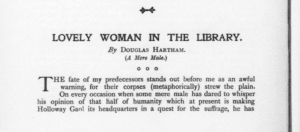
Library World, 1906
He used alarming, almost predatory, language to describe an unnamed library where women worked.
“A most charming creature…”
“Recently I visited a library where the trail of the feminine is in evidence, and was particularly struck by the demure appearance of one member of the staff.” Hartham described a woman working there as “the statuesque but captivating creature behind the counter” who was joined by “another, equally entrancing but rather less statuesque” colleague.
Hartham declared that “the Lovely Woman of the library staff is a most charming creature” because any interactions with them was always “accompanied by a smile that you dream about for days”.
Using his profession’s trade journal, he joined other male librarians by questioning the benefits of employing women in libraries, filling roles that they thought should be reserved exclusively for men. Women may make “lovely” assistants, Hartham thought, but their employment came with risks:
“Suppose anything does go wrong? One cannot box their ears (Oh! the sacrilege of it) or employ a few well-chosen and forcible epithets. Besides, that propitiatory smile disarms the most truculent of trousered tyrants. I have never come across anyone who has seen a feminine assistant in tears, and we must be devoutly thankful that this powerful weapon is not employed against us. Imagine the result if they wanted anything out of the ordinary and were refused: two months’ holiday? Tears. £25 increase? Tears. Friday evening off (to see George)? Tears.”
In a subsequent issue, Pierce returned with an article that continued to defend her employment, standing up against the misogyny displayed by Hartham, Chennell and others.
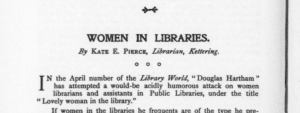
Pierce’s response to Hartham (Library World, 1906)
“I suppose even the superior male assistant must have his moments of hilarity” Pierce dryly noted, but “to make a baseless and unprovoked attack on women workers, even in jest, is neither manly nor humorous”.
A full two decades before women obtained the right to vote, Pierce lamented the attitude of some male colleagues and was quick to highlight the achievements of women in libraries.
She wrote that she had “not once discovered any of the types described by D.H… on the other hand I have found girls taking an intelligent interest in their work, acting courteously to the borrowers, doing their best to help those in search of information, and seeing that as far as possible each borrower is provided with what he or she is seeking.”
Pierce went on the attack, writing that men in library roles posed their own unique problems. “Assistants are cheeky boys, who are usually too much occupied chattering to girls to pay any heed to ordinary borrowers”, she wrote. “Their absorption in football, cigarettes, etc., is equally foolish to the feminine mind”.
Pierce closed this back and forth between her peers by imploring, with her own dry sense of humour, that perhaps male librarians should accept women into their workplaces and simply get on with their jobs.
“I have assumed from the general tone of contemptuous superiority which pervades the communication of ‘Douglas Hartham’ that he is a gentleman, or at any rate a man, and trust his patronising condescension will lead him to further study of the subject to which he has turned his giant intellect, when, perhaps, he will find that the rank and file of library assistants are not the noodles he thinks they are. The motto I should advise him to bear in mind is ‘Live and let live’ ”
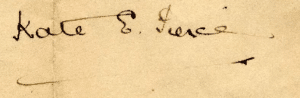
Kate Pierce was combative and outspoken when defending the rights of women, never intimidated, and always prepared to fight for equality and acceptance in the workforce. Kettering Library was a huge success, a testament to her vision and forward-thinking ideas. By 1914, she was one of the few women to become a Fellow of the Library Association, the most senior library qualification and one she was proud to achieve. From then on, she was always credited as “Kate E. Pierce FLA”.
Just one year later, she was elected to the Library Association council, the first woman to do so and a sign that she was finally being accepted by her peers. Re-elected many times, she remained on the LA council for over twenty years.
“Make their lives bigger, better, and brighter… “
The Free Library Movement was just one element of a push towards giving information and knowledge to the working classes. Regardless of background, children could now be educated in schools, and people from all walks of life could visit public art galleries and museums to learn and be inspired by history and art.
The increase in access to great works of art coincided with the career of one of Kettering’s most well-known sons, Sir Alfred East. Suffering from ill health towards the end of his life, he donated several of his artworks to the people of Kettering, hoping that an art gallery in his hometown would “make their lives bigger, better and brighter”.
A plot adjoining Pierce’s library in Manor House Gardens seemed like the ideal place to house East’s generous donation, and so the gallery bearing his name was built, opening in 1913. Once again, Sheep Street was packed with thousands of people, excited to the see the latest addition to Kettering.
Pierce’s abilities as a librarian were well established, but with the opening of Alfred East Gallery her role began to change and she adapted to a new challenge.
At first, WT Wright, a nephew of East and himself a respected local artist, was “Honorary Curator” of the Gallery with Pierce acting as his deputy. Together they oversaw the exhibition of Kettering’s art collection, dominated by the works of East. But with Wright’s untimely death in 1917, Pierce took on the role of Curator alongside her existing position as Chief Librarian.
In an era when the art world was still dominated by male artists, she sought to increase the representation of women in Alfred East Gallery’s collection. This was no easy task, and if suitable artworks by female artists were unavailable, we can see that she actively encouraged the depiction of women in the collection.
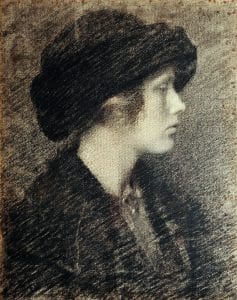
“The Black Hat” by Thomas Cooper Gotch
As well as East, the other great Kettering artist of the time was Thomas Cooper Gotch. Like East, he had become renowned for his stunning artwork, exhibiting in Paris, London, and all over Europe. But unlike East, who favoured landscapes of predominantly rural scenes, Gotch was most well-known for his studies of women.
Gotch’s The Black Hat, a charcoal study from 1912, was probably the first artwork that Pierce chose to add to Kettering’s art collection. We know from handwritten letters in the Gallery’s archives that Pierce wrote to Gotch when she became curator in 1917, keen to include his artwork in the Gallery and asking his thoughts on the frame. Gotch presented The Black Hat to Pierce, and we still hold this artwork in the collection today.
During her tenure as Curator of Alfred East Gallery, Pierce also introduced regularly changing, temporary exhibitions with more frequency. When the Gallery first opened, the focus was on permanently exhibiting the art collection, often for long periods with a large proportion of East’s work dominating the exhibition spaces. Pierce recognised that to increase the appeal of the Gallery and to encourage visitors to return, there needed to be a changing programme of exhibitions, giving visitors something new to see each time.
These exhibitions featured local artists, as Pierce continued the Gallery’s close association with Kettering & District Art Society, but she also curated exhibitions from visiting artists from further afield.
Gladys Owen was an established artist in her own country of Australia, but in the 1920s she travelled to Europe to exhibit her watercolours and woodcuts more widely, and she was successfully accepted at the Spring Salon in Paris. While staying at her sister’s house in Weekley, Owen was naturally drawn to the local art gallery and quickly encountered Kate Pierce.
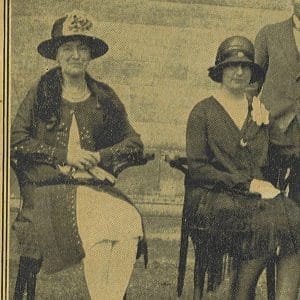
Pierce (left) and Owen, seated outside Alfred East Gallery in 1928
Pierce saw an opportunity and suggested to Owen that Alfred East Gallery should host an exhibition of her works. Owen agreed, and in June 1928 Owen’s exhibition opened. Curated by Pierce, this was the first solo exhibition by a female artist to be held at the Gallery.
When the exhibition closed, Owen was impressed by Pierce’s curation and keen to show her gratitude. She offered one of her works as a gift to the Gallery, and asked Pierce to choose whichever one she liked. “The one that I prefer is a watercolour of Sydney Harbour”, Pierce wrote. That painting was A Sydney Silhouette which has been held in Kettering’s art collection ever since.
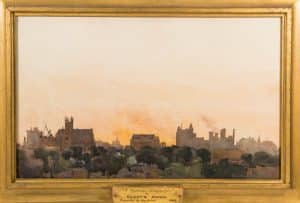
“A Sydney Silhouette” by Gladys Owen
“My dear Miss Pierce… “
Meanwhile, Pierce’s correspondence with Gotch and his family led to further acquisitions of artwork. While Alfred East Gallery includes many examples of smaller Gotch pieces, mainly landscapes of his beloved Cornwall, all of his major works are bold portraits of women and Pierce was keen to include as many as possible in Kettering’s art collection.
Through her letters to Gotch and his family – many of which are held in the Gallery’s archives – we know that they formed a close bond, particularly with Gotch’s wife, Caroline. After tragedy struck in 1931, when Thomas Cooper Gotch died while visiting an exhibition in London, there was only one place where a memorial exhibition could be held.
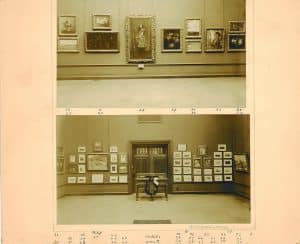
Images of Gotch’s Memorial Exhibition, Alfred East Gallery, 1932
Pierce began to organise what would be the defining exhibition of her career. She arranged artworks on loan from collections around the country, hurriedly sent invites to the opening, and planned the curation of the exhibition itself. Today, our archives reveal a series of letters back and forth with Caroline Gotch, written in hand and always addressed to “My dear Miss Pierce”.
The pressure was on to deliver an exhibition that befitted an artist of Gotch’s standing, both locally and nationally. Due to begin on 23rd March 1932, telegrams were sent from the Gotch family throughout the month, with last minute changes and instructions.
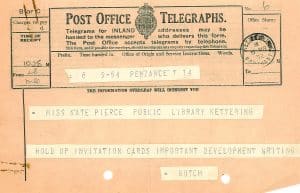
Telegram to Pierce, March 1932
The exhibition was a huge success. Visitors were moved enough to write poetry, inspired by the paintings on display, and poems were published in the local press. The profound impact of the exhibition was keenly felt throughout Kettering, and interest in acquiring more of Gotch’s works for the town’s art collection grew.
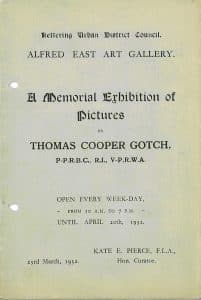
Exhibition catalogue with Pierce credited as “Honorary Curator”, 1932
Pierce was instrumental in accessioning major Gotch paintings into Alfred East Gallery. With almost 1,000 artworks in the collection today, it is testament to their quality that these key works remain as warm favourites with visitors, nearly a century later. During the period immediately after the exhibition, Pierce acquired some of Kettering’s most iconic oil paintings, bold and unforgettable depictions of strong women – artworks such as The Exile, Death the Bride, and The Vow.
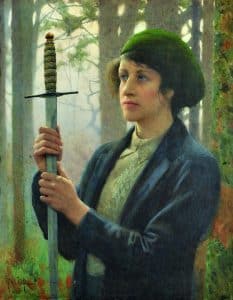
“The Vow” by Thomas Cooper Gotch
In The Vow, a young woman is seen holding a sword by its blade. With the handle forming a cross, she is striking a pose similar to that of a medieval knight taking an oath. The symbolism of this painting is a source of much debate, but one theory points towards the Suffragette movement. With the distinctive beret and her determined expression, is the subject vowing to fight for equality for women? It is said that Caroline Gotch was a supporter of the Suffragettes.
Alternatively, does the painting represent the contribution of women to the “War Effort” during World War One? We will never know for sure, but we can be certain that Kate Pierce saw something in The Vow that she liked, something that she recognised.
“Only a few trod the difficult road with her… “
After more than four decades as Chief Librarian of Kettering, Pierce retired in 1939. As Curator of Alfred East Gallery, she had worked tirelessly for over twenty years. She spent her retirement in Tunbridge Wells and died in 1966 at the age of 92, never married and with no children, opting instead to dedicate her life to public service. In her will, she left £2200 to the Library Association to fund a new generation of assistants keen to pursue a career in librarianship.
Few people from Kettering’s past can demonstrate such commitment to promoting literacy and the arts in the town, and even fewer fought so fiercely for equality for women. In closing, perhaps we can refer to Library World and the last time Pierce’s name was mentioned. In 1960, in her 80s, she visited the head office of the Library Association and was warmly welcomed. They wrote:
“She was a pioneer of the woman in library work; and for years she served as the first woman member of the L.A. Council. Her influence was great and she had many followers, although forty years ago only a few trod the difficult road with her… A woman of clear and active mind whose interest in libraries has never faltered.”