
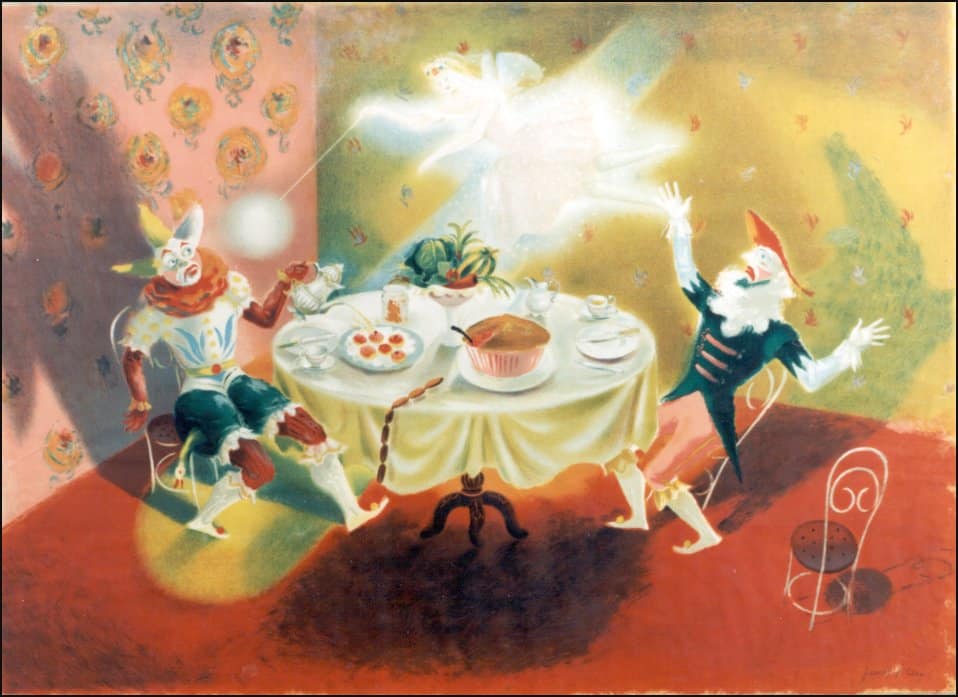
KettFest is almost here! As Kettering’s arts and culture festival returns to the Manor House Gardens, we take a look at the inspiration behind Alfred East Gallery’s walk-in art installation.
KettFest is the annual one-day festival which celebrates the best of local music, arts, and culture. Live performances and creativity fill Kettering’s streets and the Manor House Gardens will once again join the festivities, with poetry, comedy, and theatre taking centre stage.
This year, the team from Alfred East Gallery will be doing something different. Using artwork from the collection as inspiration, we will be creating a fun new way to experience Kettering’s art. January Pantomime (pictured above) will be recreated as a walk-in art installation – step inside the art, grab a photo, and enjoy Kettering’s art collection like never before. Actors from Laugh Out Loud Theatre Company will help to bring this anarchic scene to life, alongside craft activities and reproductions of other paintings from the collection as excitement builds for the Gallery’s reopening later this year.
James Fitton’s January Pantomime has been in Kettering’s art collection since 1977. Created during the Second World War, its history and the artist’s life is a key reason why this lithograph has been chosen for KettFest.
Who was James Fitton?
James Fitton was born in 1899 in Oldham, a town at the centre of the cotton-spinning industry. He grew up surrounded by an industrial landscape, where his family’s terraced house backed onto the mill where his mother worked.
Living in relative poverty, the Fitton family worked hard. His mother operated 6 looms during 11-hour shifts, and she continued working even while heavily pregnant, only having a few days off for Fitton’s birth. His father began his working life at just 7 years old. While still a child, he was caught in machinery while cleaning under the looms and lost an ear.
Later, Fitton’s father worked in the steel industry. After living in cramped houses and working long hours with little pay, he became involved in the beginnings of the Labour movement. He helped to form a union and led strikes for better working conditions. He was sacked for his beliefs, blacklisted amongst local employers, and forced to use a fake name to find work far from home.
Fitton first became interested in art when he was 8 years old. After a series of ear infections, he underwent surgery on his kitchen table, a procedure that left him permanently deaf in one ear. He began to draw when he was in hospital and away from school. When he finished school at aged 14, his headmaster said “[Fitton] won’t be good at anything – that is except drawing.”
While working in textiles factories, Fitton studied in evening classes at Manchester School of Art. He studied alongside the artist L.S. Lowry, and they became good friends.
In 1920, Fitton and his family moved to London where he worked as a freelance illustrator before gaining a permanent job at Vernon’s advertising agency. He was promoted to Art Director and stayed there for 50 years.
Fitton was a successful artist in varied mediums – painting, lithographs, advertising, and theatrical design. Perhaps influenced by his father’s activism, he was also a renowned political cartoonist during the ‘30s, with his cartoons regularly published in left-wing newspapers The Daily Worker and Left Review.
His paintings, often depicting family members and scenes of working-class life, were first exhibited at the Royal Academy in 1929 before becoming a regular feature of the Summer Exhibition. He was elected a full Academician in 1954.
As an advertising artist, Fitton’s signature use of bold colours could be seen in work for the London Underground, the Ministry of Food, and in wartime posters giving safety guidance during the blackouts of the Blitz. He designed film posters for Ealing Studios, most notably the British 1949 classic Kind Hearts and Coronets. His lithograph, January Pantomime, was produced for the Council for the Encouragement of Music and the Arts (CEMA).
Fitton died in 1982. His artworks are held in collections around the country. As well as Alfred East Gallery in Kettering, his work can be found in Tate, the V&A, the Royal Academy, and London Transport Museum.
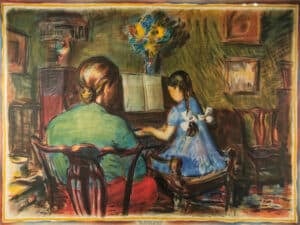
The Piano Lesson by Ruskin Spear
© Estate of Ruskin Spear / Bridgeman Images
What was CEMA?
Formed in 1940, the Council for the Encouragement of Music and Arts aimed to promote British culture and improve morale during World War II. Funded by the government, it sought to boost wellbeing by staging concerts, plays, and art exhibitions in areas that had been particularly affected by the war. CEMA focussed on regional diversity and worked in industrial towns and rural areas away from the big cities.
In a 1942 promotional film, R.A. Butler MP explained that CEMA “took music and the arts to factories, mining towns and seaports which may have suffered in the war or cut off from normal sources of entertainment”.
James Fitton’s lithograph, January Pantomime, was produced for CEMA and likely formed part of a series commissioned to achieve the Council’s goals. Alfred East Gallery holds three other artworks from that series. Also lithographs, they depict quintessential British pass times and an idyllic perspective on British life.
- January Pantomime shows clowns enjoying tea and cake in that most British of theatrical traditions – the panto.
- In Chiswick Reach by H.E. Du Plessis, we can imagine a peaceful stroll by the River Thames as swans and sailboats drift by.
- Ruskin Spear’s The Piano Lesson depicts the interior of a 1940s sitting room as a child learns to play music (pictured above).
- September: Hop Picking by H.S. Williamson hops being harvested, ready to be brewed into the nation’s favourite tipple – beer.
CEMA was “a wartime inspiration… bringing the best to as many people as we can to cheer them on to better times”. This was the first time a UK government had funded arts and culture in this way, and it was seen as a great success story amongst the gloom of the Second World War. People were keen for this to continue in peacetime, and CEMA was disbanded to make way for the Arts Council, which continues to support and inspire creativity to this day.
KettFest takes place throughout Kettering town centre, and Kettering Town Council’s full programme of events can be found here. In Manor House Gardens, Kettering Library’s popular Spoken Word Stage returns alongside the Gallery’s art installation. A full rundown of our day can be seen here.
Main Image: January Pantomime by James Fitton R.A. © Judy and Tim Fitton